Telehealth
Vous trouverez dans cette section:
- What is telehealth?
- What are the advantages of teleconsultation?
- Is it secure and confidential?
- How to access telehealth services?
- Are there fees for receiving telehealth care or services?
- How do you prepare for a teleconsultation?
- What if you have a problem with your computer?
- Are teleconsultations recorded?
- What are your rights and responsibilities as a user?
- You no longer want to meet your professional or doctor remotely. Can you go back to seeing them in person?
- What can you do if you’re dissatisfied with telehealth services?
- Who’s responsible for telehealth?
- Continuous improvement
- Evaluation of your experience with telehealth services as a user or a caregiver
What is telehealth?
Telehealth is a health and social services initiative using information technologies that allows users to access a doctor or a health professional remotely in response to a clinical need.
Consulter la fiche d'information sur la télésanté du CISSS du Bas-Saint-Laurent.
La télésanté, c'est 6 activités:
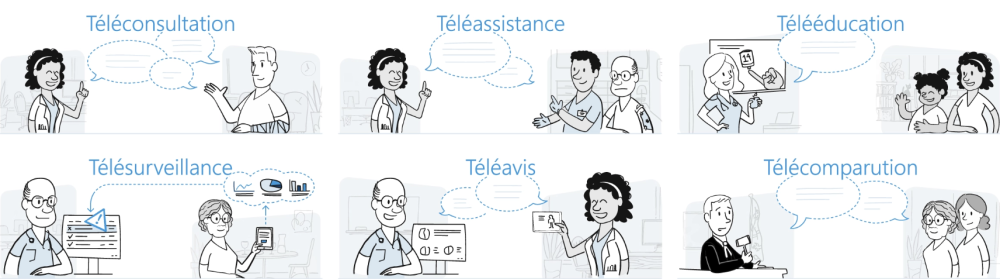
Source : Qu’est-ce que la télésanté? | Réseau québécois de la télésanté
What are the advantages of teleconsultation?
- Users have access to care and services of the same quality as those offered during in-person consultations, as close as possible to your home or even in the comfort of your home.
- Users can avoid having to travel to appointments (while reducing your environmental footprint!) as well as the fatigue and costs involved.
- Patients don’t have to spend time in waiting rooms and reduce time-off from work or school.
- Users have easier access to specialized expertise in more remote regions.
- The risks of contracting hospital-acquired infections are reduced.
- Family members can participate and accompany users from different locations.
Is it secure and confidential?
The telehealth tools are recommended and certified by Québec’s Ministère de la santé et des Services sociaux. While institutions employ all the reasonable means to protect users and their information, the risks associated with telehealth are still possible.
How to access telehealth services?
Telehealth services are still being expanded and are not yet available for all types of care. If you’d like to take advantage of telehealth services, talk to your health professional.
When consulting for care or services, you’ll be informed if the teleconsultation option is available and applicable to you. You may, at any time, choose to continue receiving in-person services.
Are there fees for receiving telehealth care or services?
No, there are no fees related to telehealth services provided by the CISSS du Bas-Saint-Laurent.
How do you prepare for a teleconsultation?
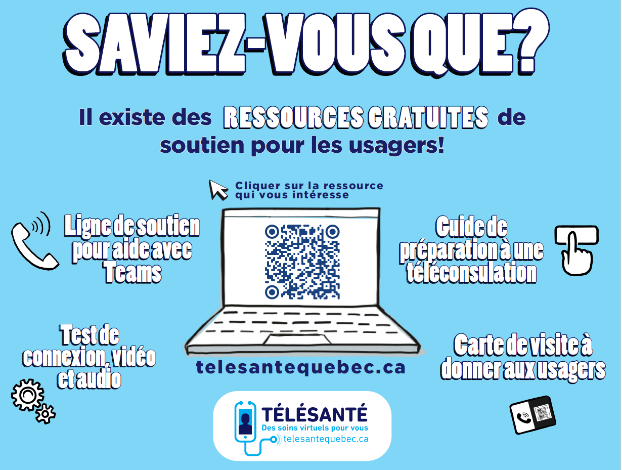 Before your virtual appointment, prepare your list of questions, including a list of your symptoms, medications and concerns that you wish to discuss with your health professional. It’s important to be well prepared to avoid technical problems and to have everything you need on hand to ensure that the appointment goes smoothly. Before your appointment, consult these instructions You’ll also find the steps involved in a teleconsultation.
You can test your technological equipment, by visiting Réseau québécois de la télésanté | Test the technological equipment. It’s also important to ensure your privacy:
- Use a secure device and have a reliable internet connection.
- Always use your first and last names on authorized platforms.
- Be in a calm and private place.
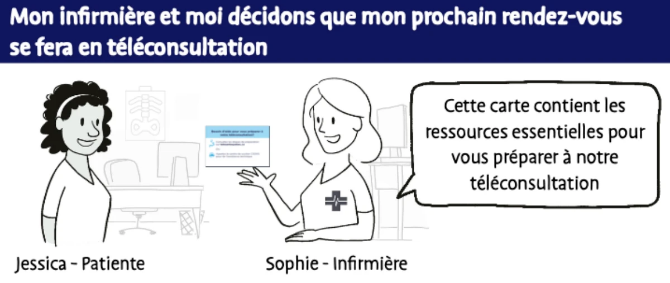 |
Extrait du document explicatif Mise en situation pour l’utilisation de la carte de visite |
What if you have a problem with your computer?
Sometimes the connection may be interrupted. If this happens, connect again using the link provided in the invitation. In case of major technical problems, your professional may try to reach you by phone. Don’t hesitate to validate this alternative with the professional before your appointment.
For technical issues related to Teams (videoconferencing app), you can contact the provincial support centre:
- By phone: Monday to Friday, from 7 a.m. to 6 p.m., at 1-833-564-0404 (toll free in Québec)
- By phone appointment with a technician: If you prefer to receive a call from a technician at a convenient time, book an appointment with a technician.
Are teleconsultations recorded?
Non. Toutefois, dans un contexte où le médecin ou le professionnel demande d’enregistrer une vidéo, un consentement spécifique est requis si la consultation doit être enregistrée. Ce consentement peut être verbal ou écrit. Des notes de rencontre pourraient cependant être recueillies par le médecin ou le professionnel.
What are your rights and responsibilities as a user?
- You have the right to refuse a remote appointment.
- You are responsible for being well prepared for your appointment and having the necessary information and documents (e.g., identification) on hand.
- For more information, go to : participating in a teleconsultation as a patient
You no longer want to meet your professional or doctor remotely. Can you go back to seeing them in person?
Yes. If you want to stop remote appointments, you can talk to your professional or your doctor to look at alternatives. They have your interests at heart and their professional responsibility to you remains the same, whether the consultation is remote or in person.
Under the Act respecting the governance of the health and social services system (ARGHSSS), a patient has the right to accept or refuse an intervention by a health professional. This means that you have the right to:
- be informed of the services and resources available, such as telehealth;
- participate in decisions that concern you, such as the choice of consultation;
- change your mind along the way if you prefer not to have your future consultations via telehealth;
- withdraw your consent at any time, so never hesitate to ask questions and discuss them with your health professional!
What can you do if you’re dissatisfied with telehealth services?
What can you do if you’re dissatisfied with telehealth services?
Users who are dissatisfied with the services they received or should have received can file a complaint with the Quality Service and Complaints Commissioner. All the information is provided in the users’ complaints and rights section (in French) on the CISSS du Bas-Saint-Laurent’s website.
Who’s responsible for telehealth?
In Québec, telehealth activities are coordinated by the Réseau québécois de la télésanté (RQT).
At the CISSS du Bas-Saint-Laurent, the team of telehealth respondents is there to help you. If you have any questions, contact them at telesante.cisssbsl@ssss.gouv.qc.ca.
Continuous improvement
The CISSS du Bas-Saint-Laurent is committed to involving users as well as their caregivers in developing its organizational strategy for telehealth services.
Getting involved in telehealth development as a user or caregiver
The delivery of quality telehealth services depends on collaboration with users and caregivers. We’re actively looking for people who would like to work with us to support the design, delivery and implementation of telehealth services.
Your participation means sharing your perspective to improve the practices of support workers as well as health professionals, review documents (pamphlets, guides, surveys, etc.), complete questionnaires during your trajectory, or participate in a committee dedicated to improving care, services or care pathways.
Participate in improving care and services! Fill in the online form (in French) now, and join our regional bank of user partners.
For more information, visit:
- Devenir usagère ou usager partenaire (in French)
- L'Approche aidance Bas-Saint-Laurent (in French)
- Site Web gouvernemental - Personne proche aidante
By email :
Evaluation of your experience with telehealth services as a user or a caregiver
We want to know what you think! Please take the survey.

Mise à jour : 25 février 2026