Cancer investigation hub

The cancer investigation hub (GIC) supports patients when tests are required to confirm or rule out a cancer diagnosis. The investigation pathway includes all stages, from the first examination to the treatment decision, and aims to ensure coordinated follow-up care and reduced wait times.
The GIC does not replace your family doctor or specialist physician, but works in collaboration with them throughout your care journey.
What type of support is offered?
As soon as you’re referred to the GIC, you’ll be supported throughout the process by a clinical nurse. The nurse remains available, as needed, to answer your questions and guide you through the investigation process.
What the nurse does for you:
- answers your questions about the process and the different stages of investigation;
- ensures the investigation progresses quickly;
- monitors and coordinate your overall care pathway;
- directs you to health resources (nutrition, smoking cessation, psychosocial support, kinesiology, etc.).
What you should know before your first phone call
- During the first call, your nurse will explain your investigation pathway and answer your initial questions.
- Prepare your medication list, as well as a list of topics you’d like to discuss (concerns, requests for information, expectations regarding your health condition).
- Don’t hesitate to ask all your questions so that you’re well informed and better understand the next steps.
- If possible, it’s recommended that you be accompanied by a caregiver during your medical appointments throughout the investigation process. Their presence can help you better understand the information provided, ask questions you may not have thought of and receive emotional support.
Support is available: the GIC is there to help you.
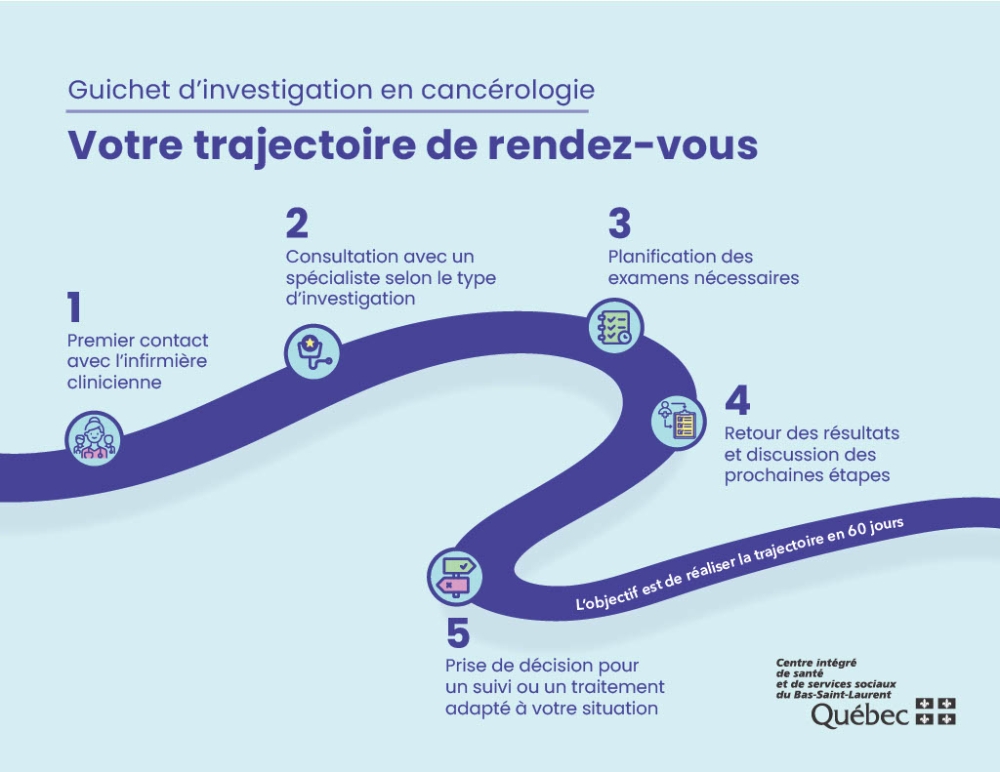
Next steps: your appointment pathway
Once your referral has been accepted, your care pathway will generally proceed as follows:
- initial contact with the clinical nurse
- consultation with a specialist (a urologist in the case of the prostate cancer pathway)
- scheduling of the required tests (blood work, CT scan, MRI, biopsy, etc.)
- disclosure of results and discussion of next steps with the specialist physician
- decision-making regarding follow-up care or treatment adapted to your situation
- end of the investigation period
Throughout the investigation process, the GIC nurse ensures follow-up and remains available to answer your questions.
Numéros de téléphone et contacts importants
Coordonnées de l’infirmière clinicienne du guichet d’investigation en cancérologie
- Prostate
-
Pôle Est et Ouest – même contact
- 418-724-3000, poste 41607
- investigation.urologie.dpspc.cisssbsl@ssss.gouv.qc.ca
- Poumon et Sein
-
Une infirmière est responsable de l’investigation du cancer du poumon et du sein
Pôle Est :
- 418 724-3000, poste 44191
- gui.invest.onco.dpspc.cisssbsl@ssss.gouv.qc.ca
Pôle Ouest :
- 418 868-1010, poste 63389
- ga.invest.onco.ouest.dpspc.cisssbsl@ssss.gouv.qc.ca
- Colorectal
-
Pôle Est et Ouest – même contact
- 418 868-1010, poste 62315
- investigation.colorectal.cisssbsl@ssss.gouv.qc.ca
Contacts importants
- Médecine nucléaire (Tep scan, scintigraphie osseuse)
-
- Rimouski : 418 724-3000, poste 42727
- Rivière-Du-Loup : 418 868-1020, option 2 puis option 1
- Radiologie
-
- Rimouski : 418 724-3000, poste 42991
- Rivière-Du-Loup : 418 868-1010, poste 62381
- Centrale de rendez-vous clinique externe
-
- Rimouski : 1 866 324-8591
- Rivière-Du-Loup : 418 868-1020, option 5
- Cessation tabagique
-
- Ligne J’arrête : 1 866 527-7383
En investigation ou en traitement, arrêter de fumer ou de vapoter est bénéfique.
Votre infirmière peut vous orienter vers un programme de cessation tabagique adapté à vos besoins.
Pour toute question concernant ces guichets, veuillez contacter l’infirmière.

Resources
For information about prostate cancer, go to: https://procure.ca/
1 855 899-2873