Uterine surgery
You’re going to have surgery and would like more information?
The healthcare professional supporting you is the best person to answer your questions and concerns about this procedure.
To complement the information provided by your healthcare professional, you’ll find various documents and information on this page:
- Brochure on uterine surgery pathway
- Booklet on uterine surgery
- Educational videos for gynecological surgery
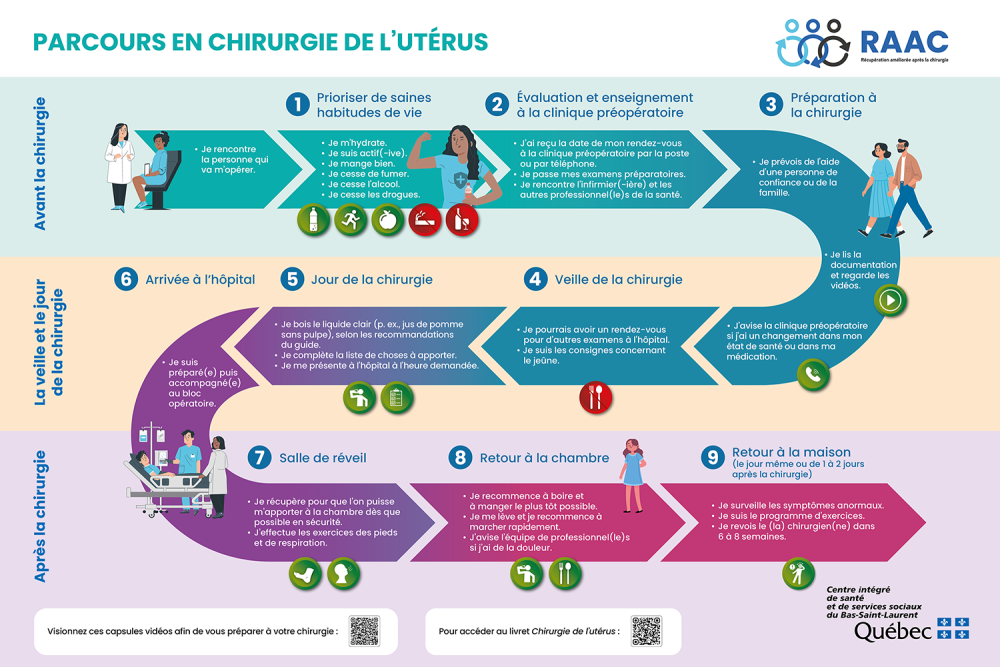
Prioritizing healthy lifestyle habits is one of the factors that contributes to success, helping to improve your overall experience and support a quicker return to your daily activities.
What is uterine surgery?
 Uterine surgery, called a hysterectomy, involves removing the uterus entirely. This procedure can be performed through an abdominal, vaginal or laparoscopic approach, depending on the medical condition and the care team’s assessment. The goal is to improve quality of life by treating certain gynecological conditions.
Why is uterine surgery performed?
The main indications that may lead to uterine surgery include:
- Uterine fibroids
These benign tumors can cause heavy bleeding, pelvic pain or pressure on the bladder or rectum. - Abnormal bleeding
When bleeding is excessive, prolonged or irregular, and does not respond to medical treatment, a hysterectomy may be considered. - Uterine prolapse
Weakening of the pelvic muscles can cause the uterus to descend toward the vagina, leading to discomfort and urinary or sexual problems. - Endometriosis or adenomyosis
These conditions, which involve the abnormal presence of endometrial tissue outside or within the uterine wall, can cause chronic pain and menstrual disorders. - Cancer or precancerous lesions
A hysterectomy may be recommended in cases of cancer of the uterus, cervix or ovaries, or when precancerous lesions require surgical treatment. - Other situations
In some cases, a hysterectomy may be considered for permanent contraception, irreversible infertility, a family history of cancer or as part of gender-affirming care.
What are the types of surgical approaches for uterine surgery?
Depending on your medical condition, your overall health and the surgical team’s assessment, different approaches may be used to perform a hysterectomy. Each approach has its own advantages and characteristics.

Laparoscopic hysterectomy
Small incisions are made in the abdomen to insert a camera and surgical instruments. The uterus is then removed through the vagina.
Vaginal hysterectomy, with or without laparoscopy
The surgery is performed entirely through the vagina, or partly through laparoscopy and partly through the vagina.
 Hysterectomy by laparotomy
The surgery is performed through an incision in the lower abdomen.
 With or without removal of the fallopian tubes and ovaries
During a hysterectomy, your gynecologist may also remove the fallopian tubes and/or ovaries, depending on your age, medical history and overall health. This decision is made together with your doctor, taking your needs and preferences into account.