Long-term housing, care and services policy
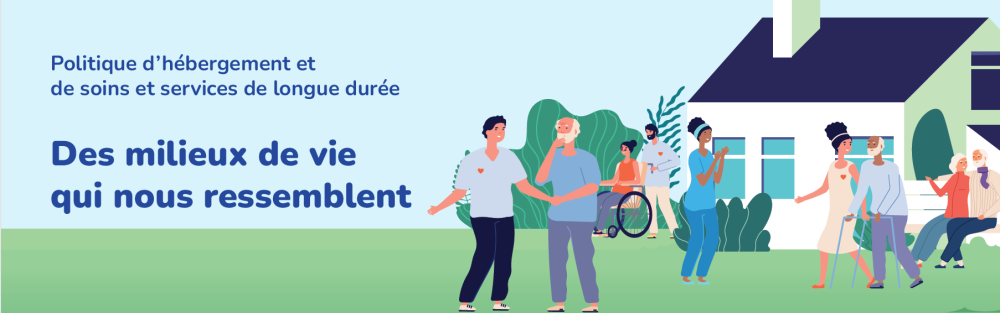
Vision
 The pathway to a residential resource and living in this new environment must be part of a continuum of the user’s history and life experiences as well as their values, preferences, needs, culture and language.
The living environment evolves and adapts to the person’s various needs, allowing them to feel at home, maintain relationships with their loved ones, and pursue and develop their social roles, while having access to the care they need for their condition.
Target groups
- Seniors experiencing loss of autonomy
- People with an intellectual disability, autism spectrum disorder (ASD) or a physical disability
- People with a mental health disorder
- People dealing with addiction or homelessness
Target living environments
- Residential and long-term care centres (CHSLDs)
- Intermediate resource (IRs)
- Family-type resources (FTRs)
- Seniors’ homes (SHs)
- Alternative homes (AHs)
Guiding principles
- Respecting personal dignity
-
Dignity is part of human nature. It is objective and immutable, but also subjective, shaped by our own perception and that of others.
- Human rights and self-determination
-
Self-determination means making decisions for yourself.
- Fostering a partnership with users
-
Partnership is an approach based on the relationship between users, their loved ones and the stakeholders in the health and social services network.
This relationship focuses on complementing and sharing respective knowledge as well as the way the various partners work together. More specifically, the relationship fosters trust and recognizes the value and importance of each person’s knowledge, including the experiential knowledge of users and loved ones, as well as co-construction.
- Promoting the resident’s well-being
-
Promoting well-being means working to improve the well-being of users and offering them the best possible conditions.
- Personalizing care, services and the living environment
-
Personalizing means adapting a product, service, residence or other offering to the personality of the user, based on their values and their life story.
- Promoting and ensuring well-treatment
-
Well-treatment fosters a senior’s well-being, dignity, personal fulfilment, self-esteem, inclusion and sense of security.
It is expressed through attentiveness, attitudes, actions and practices that respect the person’s values, culture, beliefs, life trajectory, individuality as well as their rights and freedoms.
Focus areas
- Focus 1 : The resident
-
 Regardless of gender, skills, autonomy and culture, a resident must be considered as a whole and unique individual. The living environment must correspond to the profiles of the adults who live there.
At all times, the person living in or integrating a residential resource must be a stakeholder in the process because they:
- have capacities;
- remain in control of their life and decisions;
- must have the opportunity to express their choices (verbally and through their actions) and know they’ll be heard;
- must be respected in terms of their self-determination (decision-making capacity);
- must feel at home, regardless of the living environment.
- must be supported and surrounded by people who are caring, kind and competent;
- must be able to be supported and surrounded by their loved ones;
- must have the opportunity to pursue their role in society and preserve their identity;
- must be given the conditions needed to integrate into their living environment;
- must be involved (supported or represented by a loved one or legal representative) in developing their care plan and individualized service plan.
Orientation 1 : Consider the person as a whole and support their participation in maintaining and developing their capacities
Orientation 2 : Ensure that the specific needs of individuals are met
- Focus 2 : Loved ones
-
 Loved ones are those who are part of the person’s social circle and who share a bond with them.
 It can be a relationship with a friend, a neighbour, a colleague, a significant other with or without legal status, or a family member. What bonds them, the nature of their relationship and how frequently they are is contact can vary.
Some loved ones will have a special role and responsibilities, for example, as the legal representative of a person who has been declared incapable.
Welcoming loved ones to preserve their relationship with the resident, getting to know them, enlisting their participation and supporting them means they:
- feel they have a place in the person’s living environment;
- can maintain their social relationships (romantic, intimate or friendship) with the resident;
- have access to lounging and gathering area, but also a private space where they can be alone with the resident;
- pursue, when possible, the same activities they enjoyed before their loved one was living in a residential resource, based on the resident’s wishes;
- have the opportunity to express their experiential knowledge and insights, and to contribute to the resident’s well-being in a spirit of partnership;
- determine and revise, at any time, the nature and extent of their involvement;
- are prepared and supported in coping with the effects of this stage and the subsequent transitions (e.g., end-of-life care, death, etc.).
Orientation 3 : Welcome loved ones with a view to preserving their relationship with the resident
Orientation 4 : Recognize and engage caregivers while respecting their wishes and their capacity for involvement.
Orientation 5 : Support loved ones
- Focus 3 : Service providers
-
 All the people who work in living environments (managers, patient attendants, professionals, technicians, technical service staff, IR-FTR coordinators, their replacements and employees, etc.) must take into account the capacities, preferences and changing needs of residents, with consideration for their culture and language.
Organizations must therefore recognize the expertise and competencies of service providers, minimize the risks to their health and occupational safety and support their decision-making autonomy. Everyone who works with users must be given consideration and must be heard since they are all full-fledged members of the interdisciplinary team.
Orientation 6 : Offer quality care and services.
Orientation 7 : Diversify the composition of the work teams.
Orientation 8 : Value and support service providers.
- Focus 4 : The living environment
-
 The concept of a living environment, as defined in the 2023 ministerial orientations, refers to a residence that is as normalizing as possible, while facilitating the resident’s integration and the personalization of their space.
 Here, the term “normalizing” refers to an environment that adopts a scale, rhythm and way of life that is as close as possible to what the resident would experience if they were still living at home.
The environments are welcoming and warm, familiar and personalized, and offer care and services 24 hours a day.
Orientation 9 : Develop a quality living environment that fosters the well-being of residents.
Orientation 10 : Develop inclusive and evolving living environments.
- Focus 5 : The community

The community is composed of many players, including volunteers who work with residents and their loved ones. Therefore, in keeping with the wishes of residents, the community must:
- be open to and interact with the living environments (bidirectional exchange);
- promote the resident’s continued activities in their local community;
- support and enable the fulfillment of the resident’s life project and social participation;
- participate in developing an intersectoral individualized service plan;
- contribute to planning activities for the living environments in their territory;
- evaluate the possibility of offering residential options (residences, apartments or other) for loved ones, close to the living environments;
- facilitate transportation and parking to ensure access to the various living environments.
Orientation 11 : Support social participation in partnership with community players.
Orientation 12 : Raise awareness of and promote the living environments among citizens.
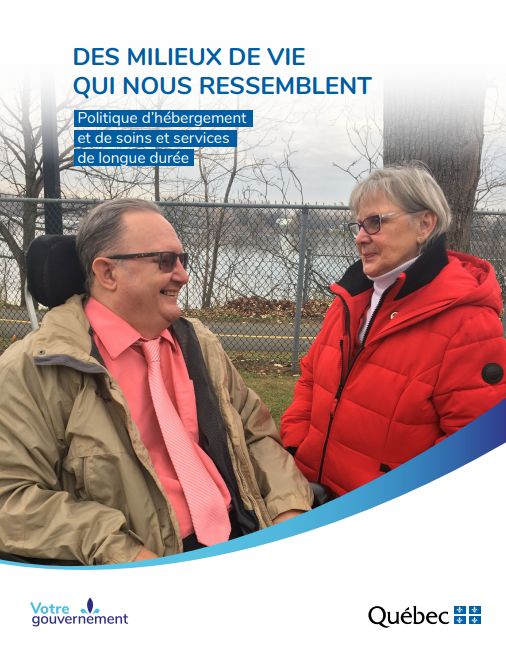
Documentation
 |
Politique d'hébergement et de soins de longue durée (in French) |
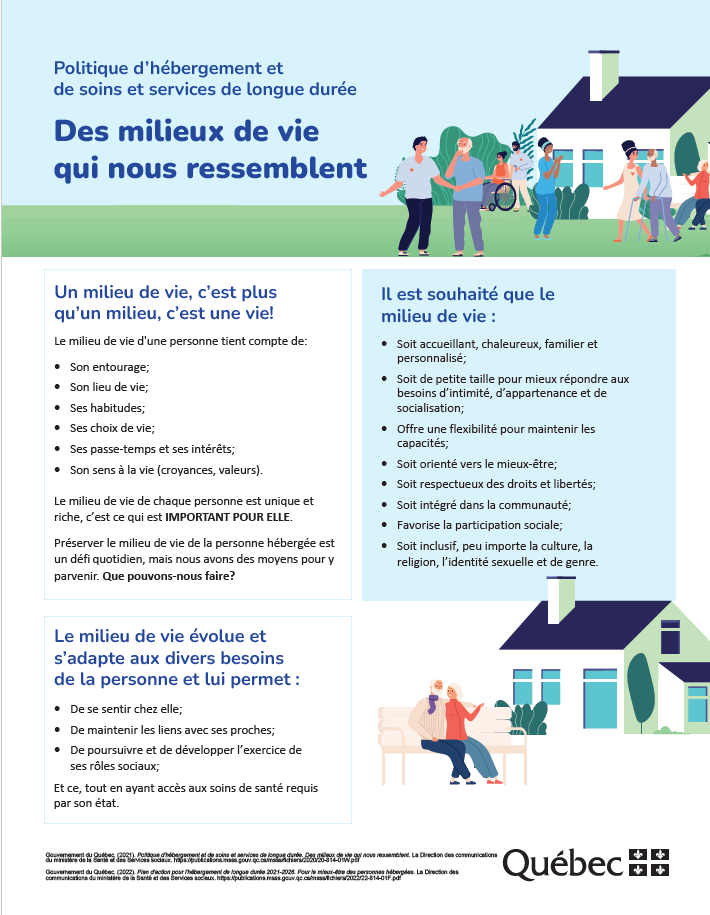 |
Politique d’hébergement - Fiche d’information (in French) |
 |
Plan d’action pour l’hébergement de longue durée 2021-2026 (in French) |
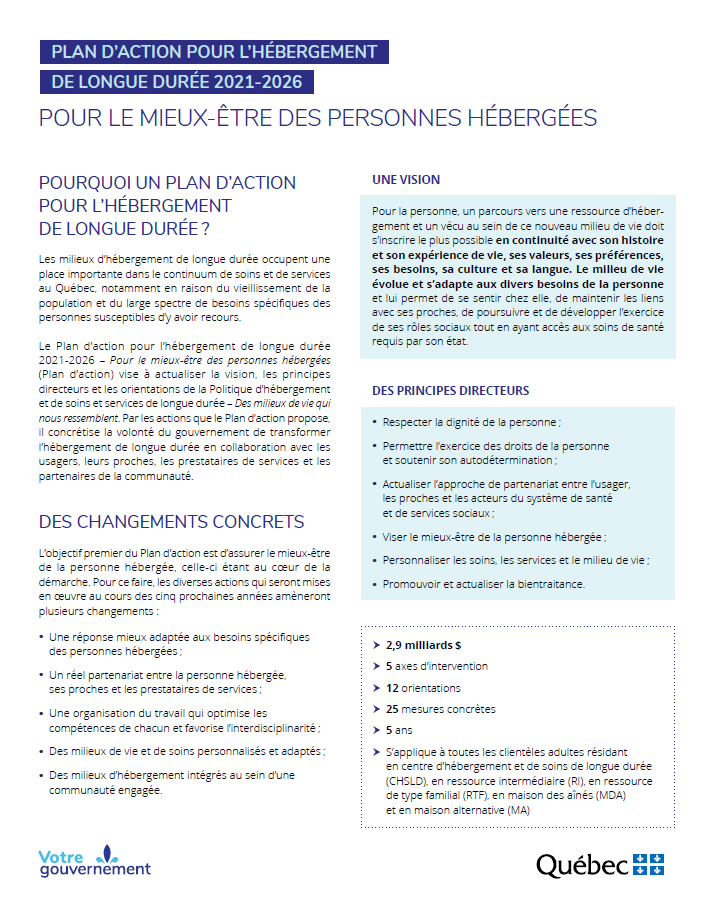 |
Plan d’action – En bref (in French) |
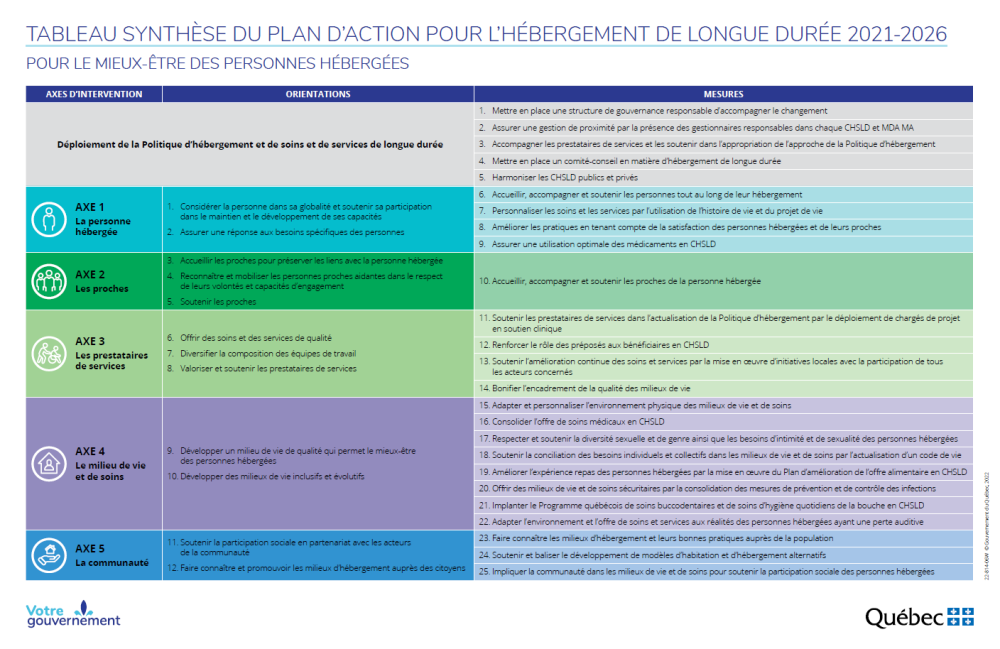 |
Plan d’action – Tableau synthèse (in French) |
To reach us
phssld.dqepe.cisssbsl@ssss.gouv.qc.ca
Policy leads of the CISSS du Bas-Saint-Laurent:
- Caroline Pelletier, Planning, Programming and Research Officer
- Andréa Fortin, Planning, Programming and Research Officer